Slavic Gods Explained: A Guide to the Pantheon
Perun, Veles, Svarog, Dažbog, Mokoš, and others. Who are the primary deities of the Slavic pantheon, and what were our ancestors seeking within them?
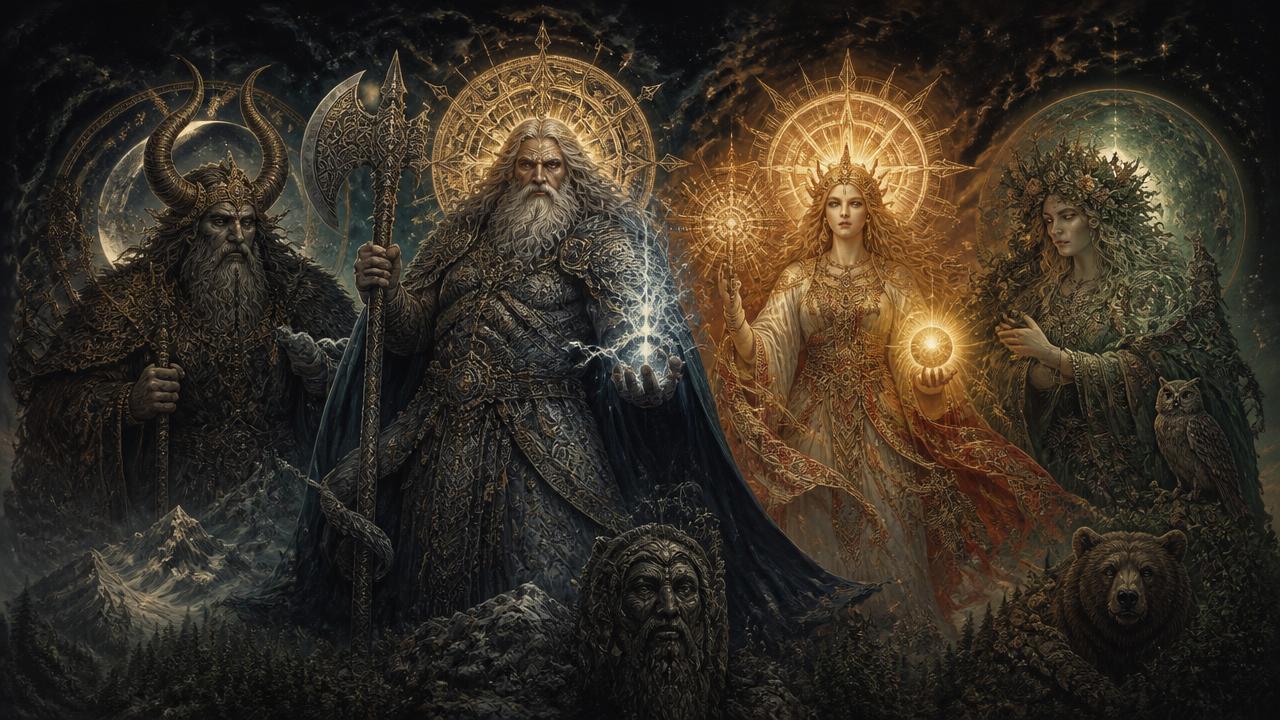
Perun — God of Thunder and Celestial Fire
Perun is one of the highest gods of the Slavic pantheon. He is the lord of the storm, thunder, lightning, war, and truth. His weapon is the axe or hammer, with which he punishes injustice and protects order.
Perun personifies the strength that comes from above — clear, swift, and uncompromising. The storm is his manifestation, and after the storm comes purity.
Veles — Lord of Paths and the Underworld
Veles is Perun's adversary and his complement. Lord of cattle, commerce, paths, poetry, and the dead. He is often depicted with horns, as a serpent, or as an old wanderer. He stands at the crossroads of this world and the next.
Where Perun personifies celestial order, Veles personifies subterranean, unknown wisdom.
Svarog — The Celestial Smith
Svarog is the god of celestial fire, the smith, and the creator. His name is linked to the blacksmith's forge in the heavens. He represents the creative energy that forges the world — not through violence, but through flame and craft.
Dažbog — The Solar Giver
Dažbog is the god of the sun, light, and harvest. His name means "the giving god" — not in the sense of falling rain, but in the sense of gifts that descend from the heavens. He personifies the warmth that ripens the grain.
Mokoš — Moist Earth and the Weaving of Life
Mokoš is the goddess of the earth, moisture, fertility, weaving, and female destinies. In traditional embroidery, she appears as a woman with raised hands, surrounded by animals. She teaches us that life is "woven" slowly, out of patience.
Lada — Spring, Love, and Beauty
Lada is the goddess of spring, love, youth, and beauty. Her name sounds soft, like the first warm days. She represents the joyful return of light after winter.
Stribog — Wind and Destiny
Stribog is the lord of the wind. His winds carry destiny, news, and change. He symbolizes that which we cannot see, but which drives us forward.
Chernobog and Belobog — The Dark and Light Guardians
According to newer reconstructions, there exists a pair of opposing forces: Chernobog (the Black God) and Belobog (the White God). They are not, however, universally recognized by all scholars; their existence is more of a modern interpretation.
Rod — The Source and Ancestral Lineage
Rod is not always a god in the classical sense. He is the source, the primordial origin, the ancestral lineage that connects ancestors, the living, and future generations. In Rodnovery understanding, Rod is sacred.
How to Read Them?
Slavic gods are not models of perfection. They are rather archetypes of the forces we feel in our lives: anger and justice (Perun), the unknown and transformation (Veles), creativity (Svarog), love and spring (Lada), patience (Mokoš).
VNORIA’s Perspective
Every god is like a threshold. When you approach them, you notice something in your life that previously had no name.